Carports on the Sunshine Coast are not like carports anywhere else, and not for the reasons most homeowners expect. The structures themselves are straightforward. The hard part is council, and council changes suburb by suburb, sometimes street by street. Before we talk about materials or design, we want to walk you through what we wish every Sunshine Coast homeowner knew before they paid a deposit on a carport that may or may not get built.
This is the honest version of the conversation we have at the first site visit.
The council reality, suburb by suburb
The first question you’d expect us to answer is “what carport do I need?” The first question we actually ask is “where do you live?” Sunshine Coast Council and the surrounding councils (Noosa Shire, Gympie Regional) all have their own planning schemes, and the newer estates often have their own plan of development negotiated between the developer and council. What’s allowed in one suburb can be flatly refused in the next.
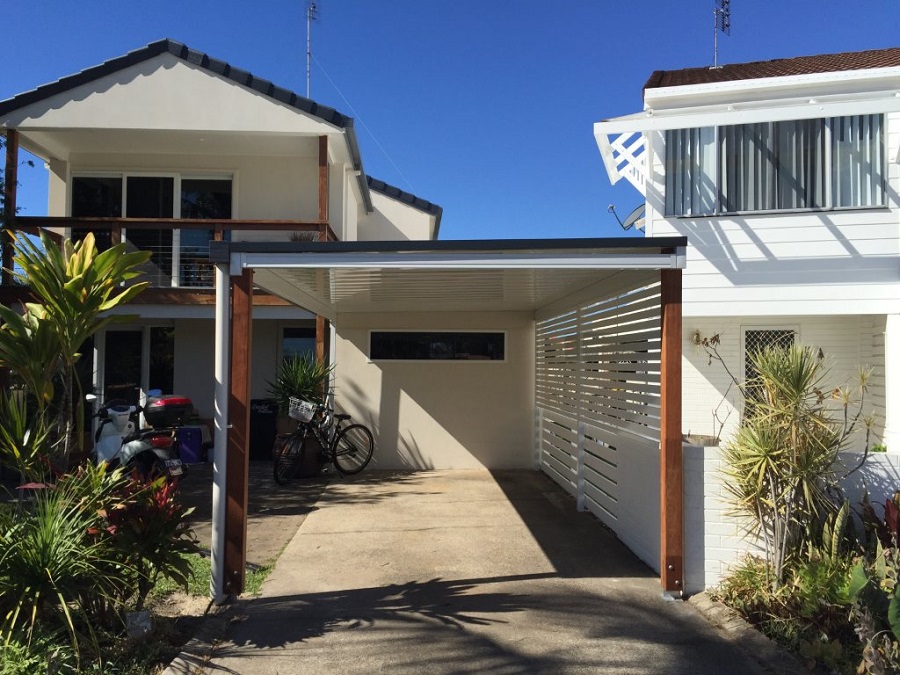
The single hardest carport to approve is a front yard carport in an established suburb. Here’s the rule of thumb we give every customer: if there are no front yard carports already in your street, you’re very unlikely to get one. Councils argue this is about “streetscape,” the idea that the street should look consistent and picturesque. We agree with the principle. We just think the answer is to require well-designed carports, not to ban them outright. But until council policy changes, the rule of thumb stands.
There’s a tell for streets where council has knocked carport applications back. Look for shade sails in front yards. People put shade sails up when they’ve tried to get a carport approved and lost. Drive your street and count them. If you see several, your odds are not good.
What it costs to try and lose
Council fees for a carport application aren’t refundable. If you apply and get knocked back, you lose what you paid council, which can come to around $2,000 once you factor in the application fee, the certifier costs, and any plans you’ve paid to have drawn up. We refund our portion if council says no, but council keeps theirs.
This is why we’ll sometimes urge a customer not to apply. If we’ve looked at your street and your plan and we don’t think the application will succeed, we’ll tell you. Some customers want to try anyway, and that’s their right. But we’d rather lose a sale than help you spend $2,000 on a “no.”
When you might not need approval at all
There’s an exception worth knowing. In Queensland, a structure under 10 square metres, no taller than 2.4 metres, and with no side longer than 5 metres doesn’t require council approval. That’s not big enough for most car carports, but it’s plenty for a small pool cabana, a freestanding garden shelter, or a single motorcycle or trailer cover. If your need is modest, the cheapest, fastest carport is the one that sits under the threshold entirely.
Sizing for the way you actually live
Most homeowners size a carport for the cars they have today. We’d encourage you to size for the cars you’ll have in five years. Cars have got bigger. Utes and SUVs dominate driveways now in a way they didn’t twenty years ago. Families have got bigger too, in the sense of more drivers under one roof. The one-car family that planning schemes were originally written for is not how households on the Sunshine Coast actually work. Most have two cars. Plenty have three or four once teenagers start driving.
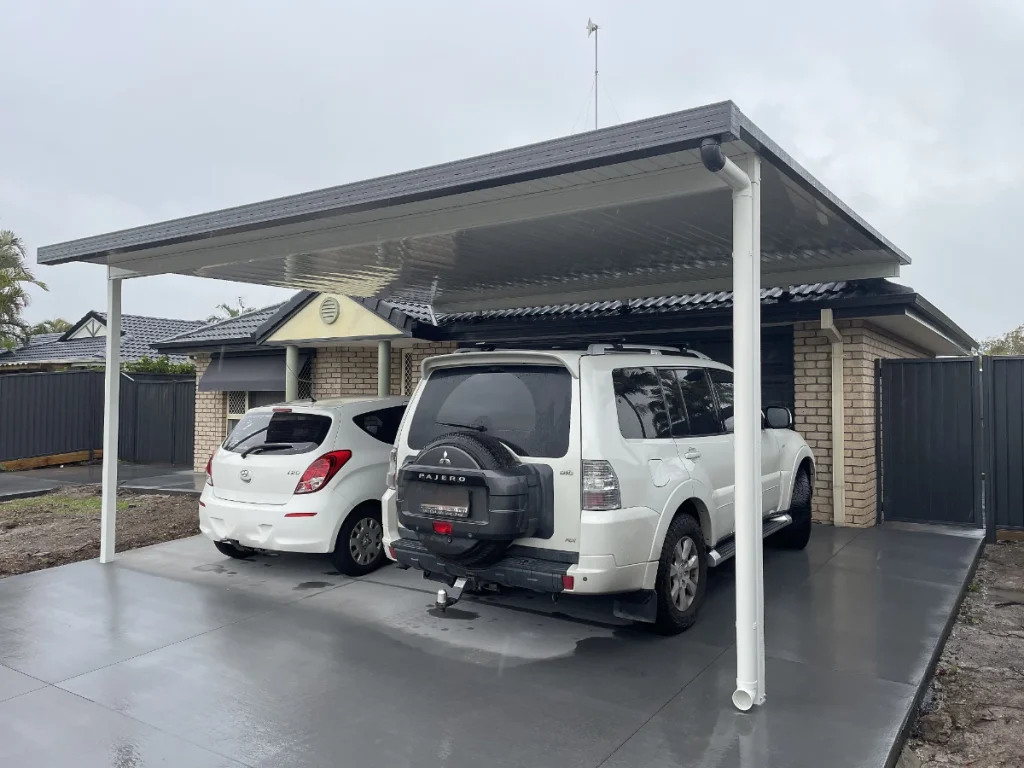
A few practical sizing points we walk customers through:
A single carport at minimum 3 metres wide and 6 metres long works for one standard car, but feels tight for a modern SUV with doors open and groceries to unload. We’d recommend 3.5 metres wide if your block allows it. A double carport should be at least 6 metres wide and ideally 6.5, so two cars can park without door-to-door drama. Boats and trailers want length more than width. Measure the actual unit on its trailer and add a metre for the towing tongue and another half-metre for breathing room. Height matters too. Standard 2.4 metres works for cars but a boat on a trailer, a roof rack with a kayak, or a tradie’s ute with a canopy can easily hit 2.7 to 3 metres. Get the height wrong and you’ll be paying for a structure you can’t actually use.
Materials and the coastal conditions reality
Sunshine Coast carports live in a harsh environment. Salt air, intense UV, summer storms, and the occasional cyclone-strength weather event from the north. The materials matter more here than they do further inland.
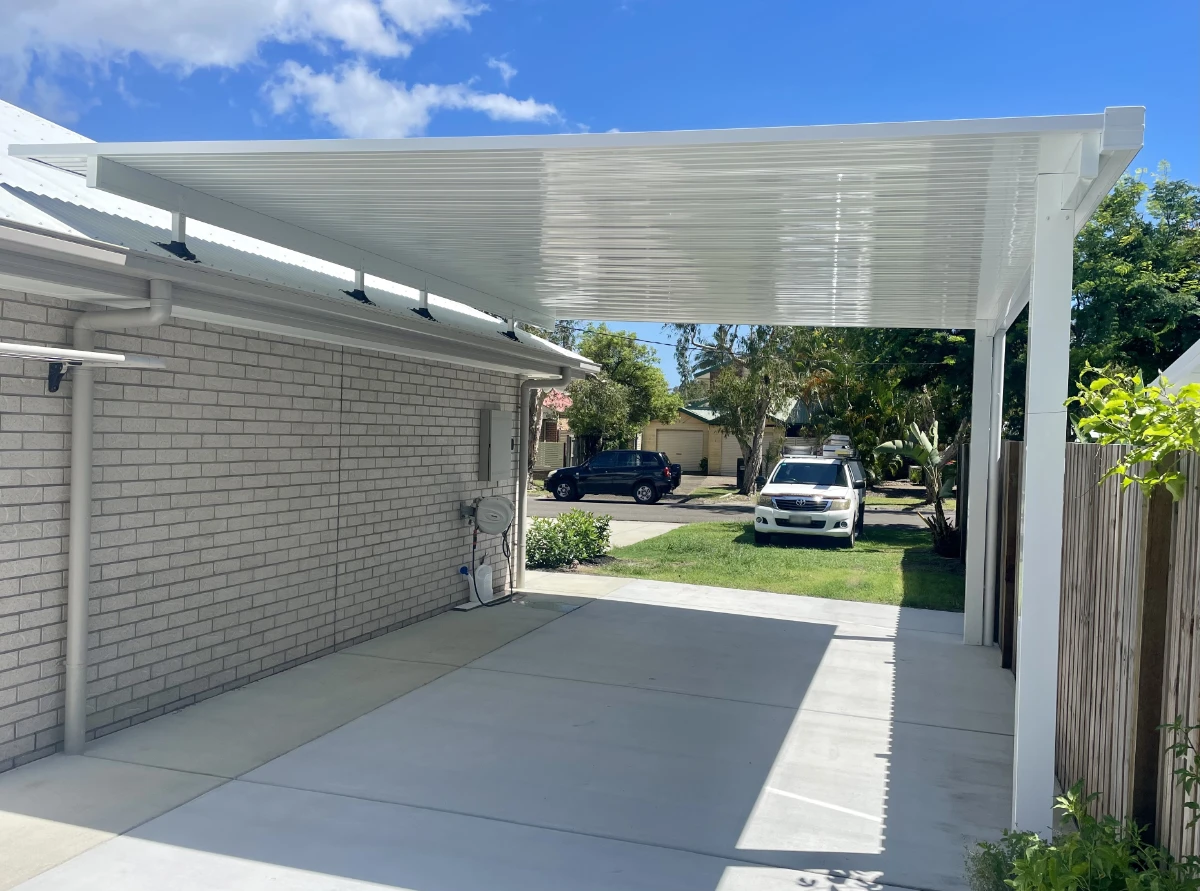
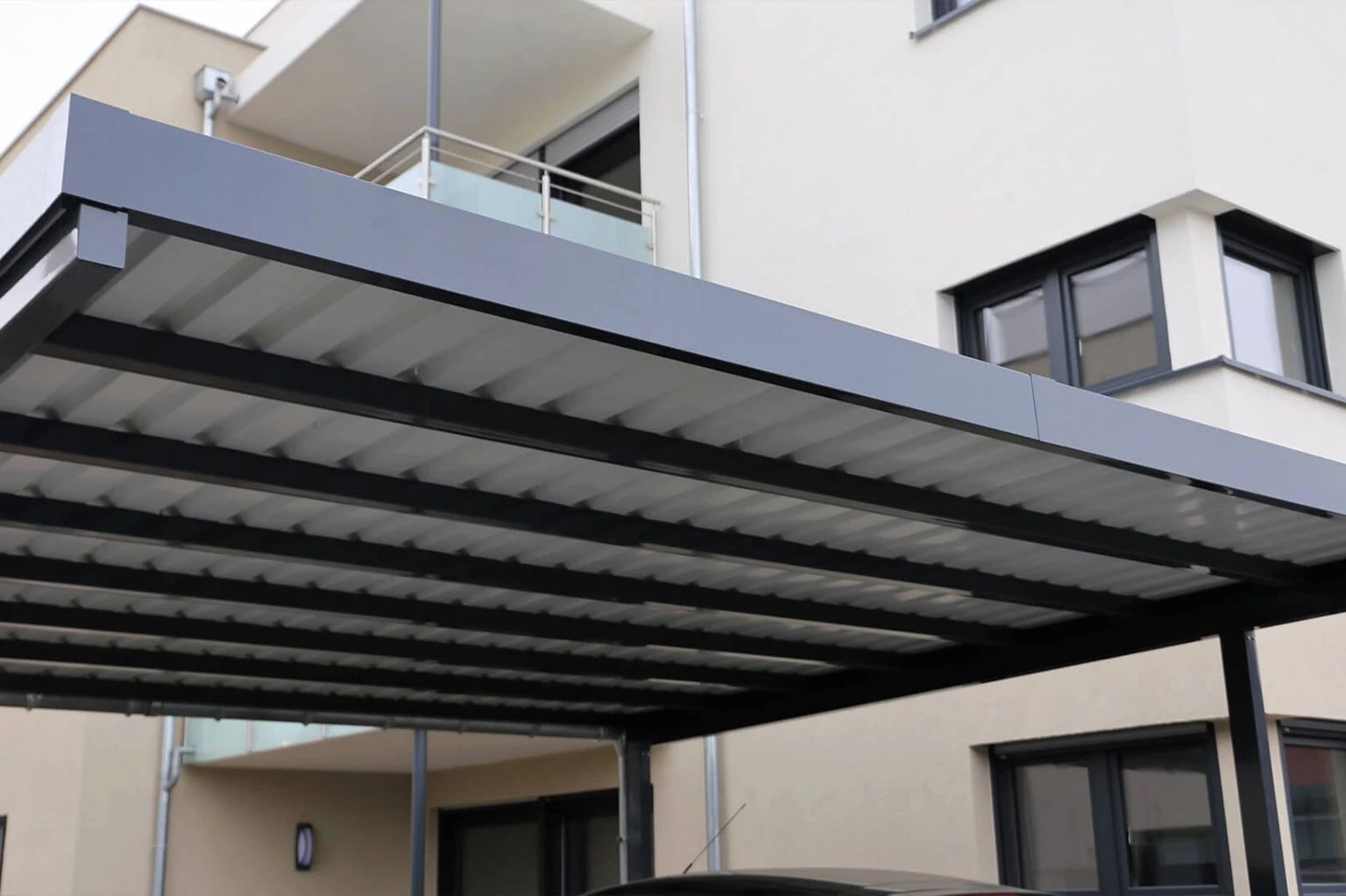
Our carports use premium coastal-rated roofing supplied by Ausdeck Building Systems, with steel structural members where strength is needed and aluminium where corrosion resistance is the priority. The posts on attached carports use internal sleeve brackets rather than exposed external fixings, which keeps water out of the join. Freestanding carports use welded base plates bolted to footings, with the post sleeving over the plate and concealing the connection. Where steel goes into concrete footings, we dome the concrete finish around the post so water can’t pool against the base and start corrosion you can’t see until the post fails.
These are details that look like overkill on a clear November day. They’re the difference between a carport that still looks new at fifteen years and one that’s getting rusty fasteners and stained posts at five.
Attached or freestanding
The simplest way to choose between them: attached carports sit against the house and use it for structural support, which means less material and lower cost. Freestanding carports stand alone, which means more material, but more flexibility on where they go.
You’ll want attached when the natural parking spot is right next to the house, the house structure is sound enough to anchor to, and the resulting carport works with the existing roofline. You’ll want freestanding when the parking spot is set away from the house (longer driveways, side blocks, double-block frontages), when the house isn’t structurally suitable for attaching to (older homes, certain add-ons), or when you want a particular look that an attached carport can’t deliver. Freestanding also tends to be the answer when the carport is for a boat, a caravan, or anything else you wouldn’t want sitting against the house.
Why a Sunshine Coast builder makes the difference
Most of what we’ve covered above is local knowledge that doesn’t transfer. A builder coming up from Brisbane or down from Gympie can build a carport. They can’t tell you which streets in Buderim have a carport problem with council, or that the new estate at Caloundra South has a different plan of development from the older parts of Caloundra, or that the bracket spec you’d use in suburban Logan isn’t quite enough for a block exposed to Sunshine Coast easterlies. We’ve been building on the Sunshine Coast for over twenty years. The local stuff is what we sell, really, more than the structures.
How to think about the decision
The order we’d recommend: confirm what your council and your specific suburb will allow before you fall in love with a design, then size for five years from now, then choose materials suited to coastal conditions, then decide between attached and freestanding based on where the parking spot is. If you start with the design and work backwards, you’ll often end up redesigning twice.
A word on price
A well-built Sunshine Coast carport is a significant spend, and we’re transparent about that. The savings on a cheaper carport almost always show up later as rust, leaks, or a structure that needs replacing well before it should.
If you’d like to talk through a carport for your home, book a free quote. We’ll come out, look at your street, look at your block, and tell you honestly whether it’s a job we think will get approved before you spend a cent on an application.
FAQs
Do I need council approval for a carport on the Sunshine Coast?
Yes, in most cases. Carports over 10 square metres, taller than 2.4 metres, or with any side longer than 5 metres require private certification and council approval in Queensland. Front yard carports are particularly difficult to approve, depending on your suburb and existing streetscape.
What size carport do I need for two cars?
A double carport should be at least 6 metres wide, ideally 6.5 metres so two SUVs can park with doors open. Standard length is 6 metres, but boats, trailers, or roof racks need extra width, length, or height to work properly.
Can I have a carport in my front yard?
Sometimes, but it’s the hardest carport approval to get on the Sunshine Coast. If no other front yard carports exist on your street, council is very likely to refuse. We assess each block before recommending whether to apply, to avoid wasting your application fees.
What’s the best material for a Sunshine Coast carport?
Colorbond roofing in a coastal-rated grade, with steel structural members for strength and aluminium where corrosion resistance matters most. Internal sleeve brackets keep water out of joins, and concrete footings should be domed at the post base.