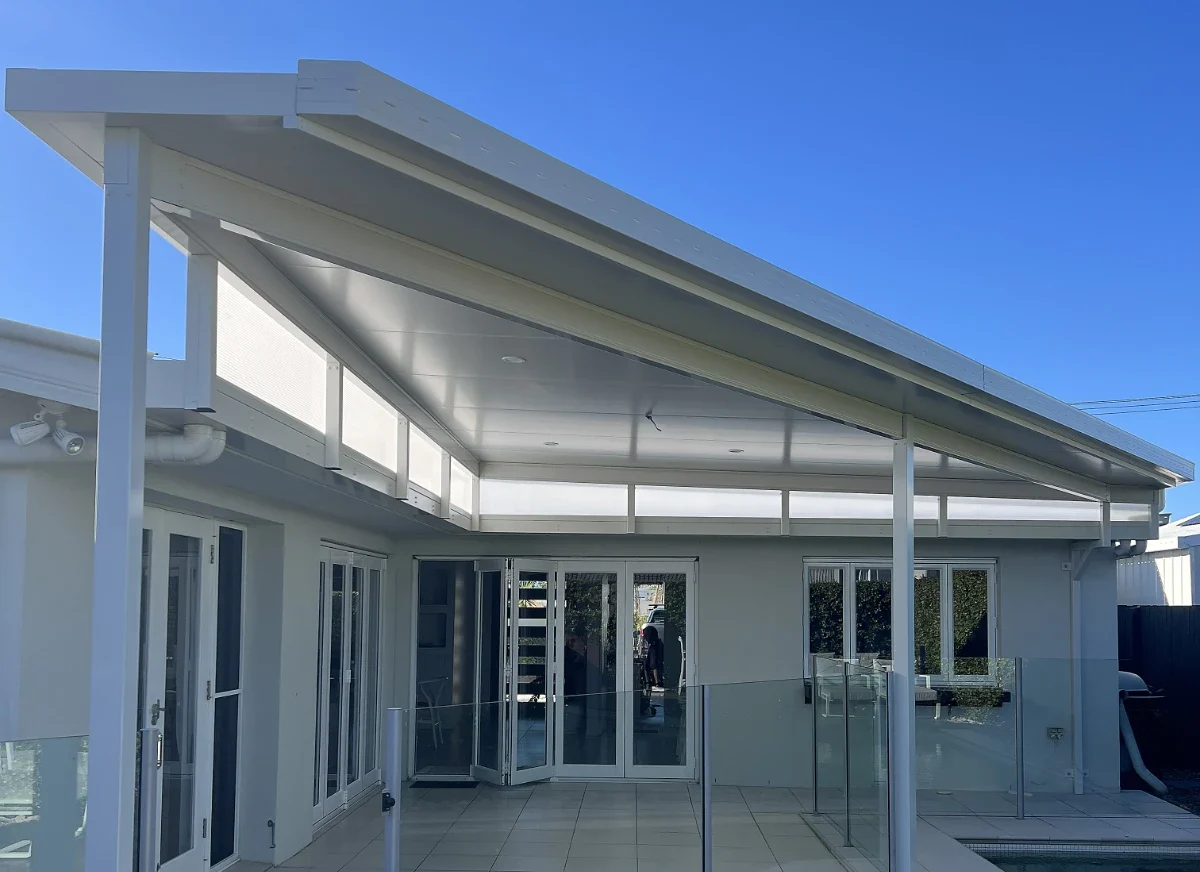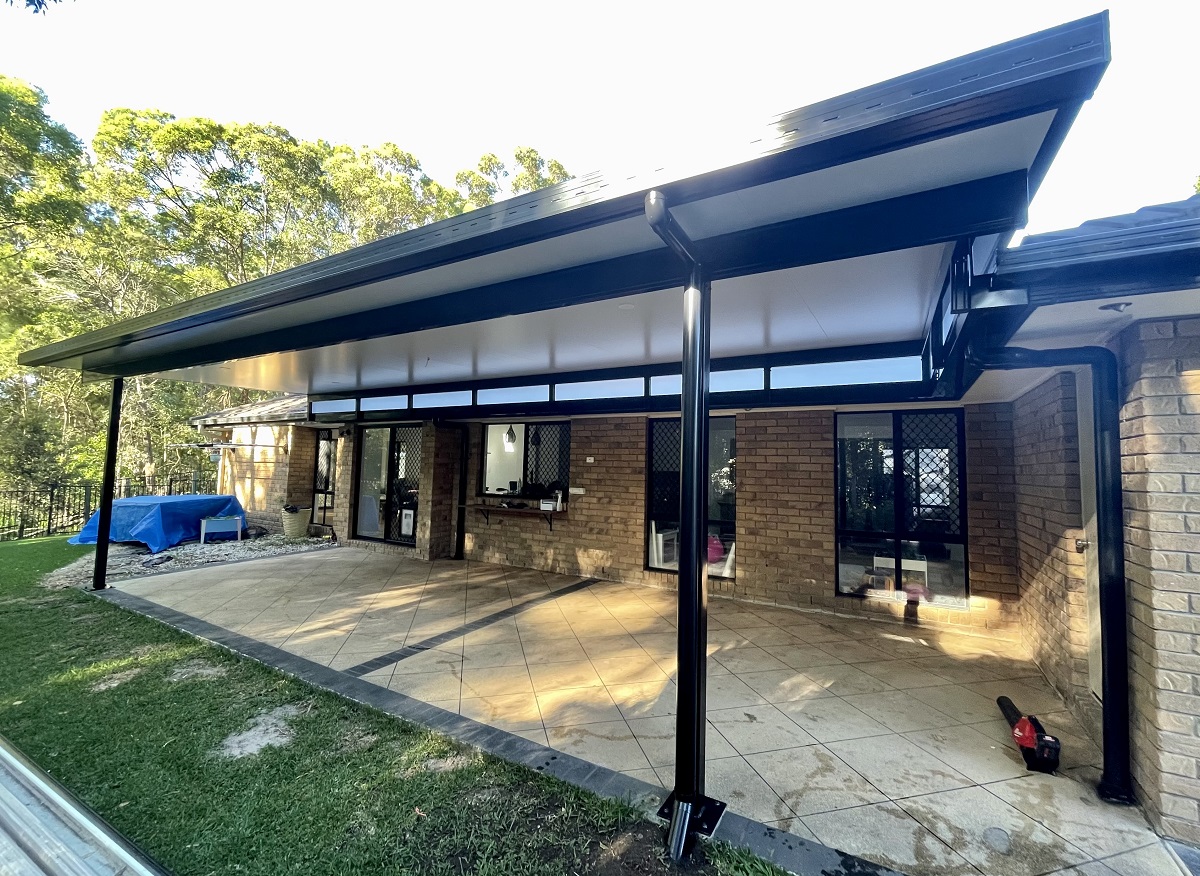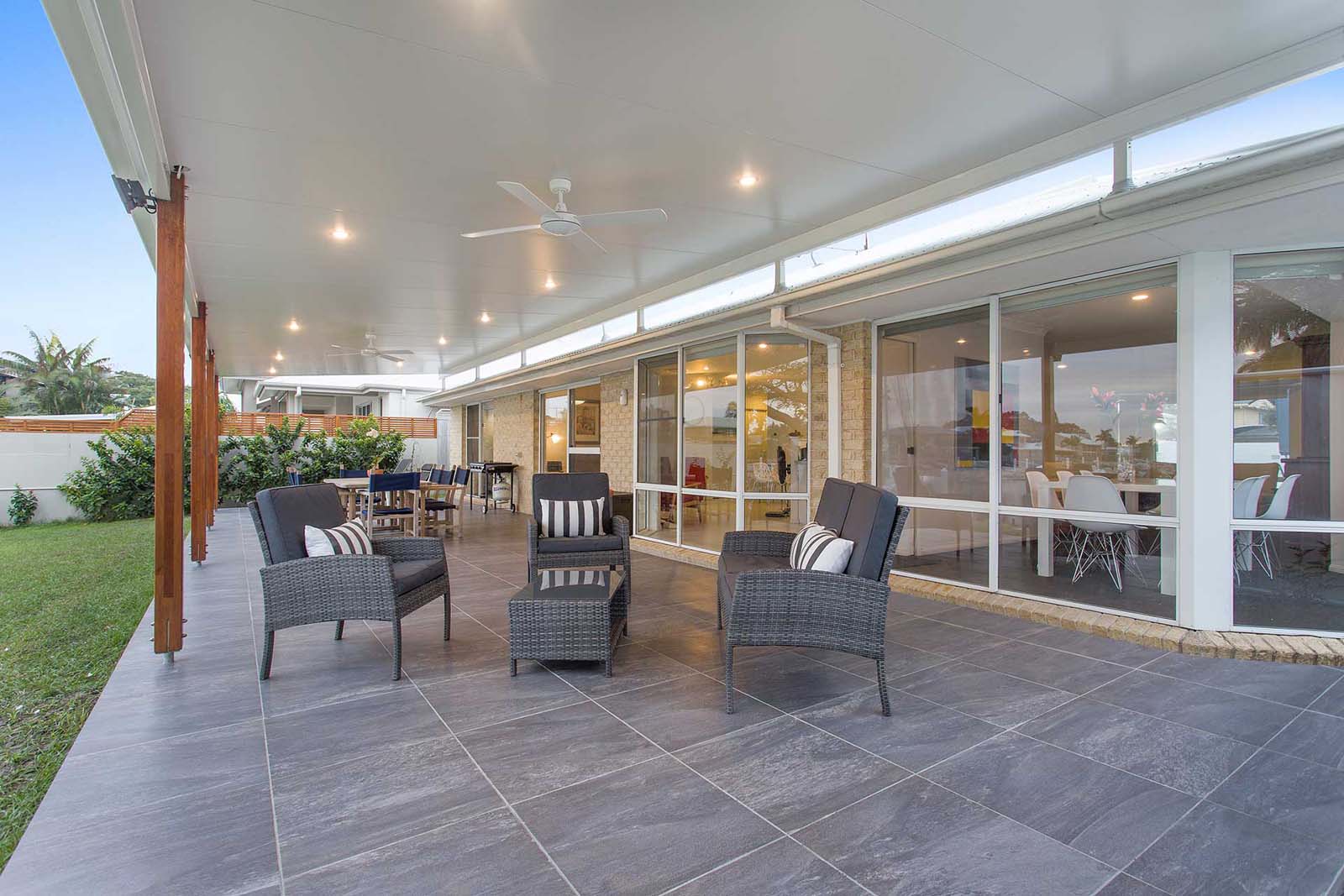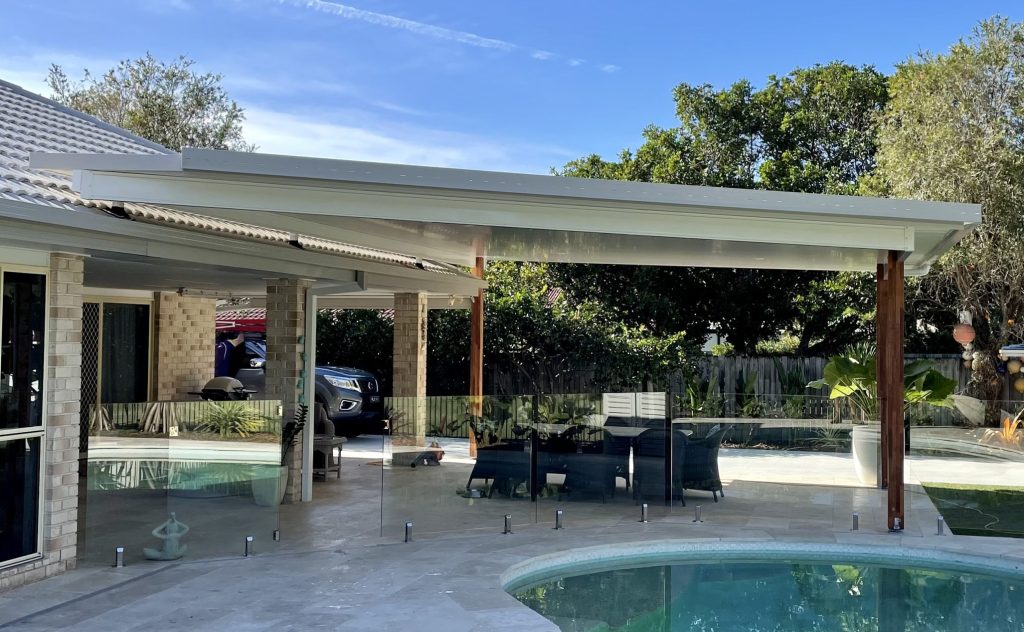
When a customer asks us about flyover patios, we usually start with the same honest line. Two patios can both be called flyover and behave very differently in a real Sunshine Coast storm, on a hot summer afternoon, and underneath your solar panels. The choice between a standard flyover and a box gutter flyover changes how much you actually use the space once it’s built, and most patio builders on the Sunshine Coast won’t tell you why.
This is the comparison we run through at every quote.
What a flyover actually does
A flyover patio sits above your existing roofline rather than attaching beneath it. The original reason for designing them this way was heat. In the old days, before insulated roof sheets became standard, single skin steel sitting in the Queensland sun would hit 80 or 90 degrees on the top surface. You could cook eggs on it. That heat radiated straight down on whoever was sitting underneath. The flyover was designed to lift the roof off the house and let that hot air out.
People often think a flyover brings breeze in. It doesn’t. It lets hot air out. The result feels more open and more comfortable, but the mechanism is different to what most homeowners expect.
These days insulated panels have largely solved the heat problem. Two layers of steel with foam between them stops the heat transferring through, so the underside stays cool no matter how hot the top gets. What flyovers still do well, even with modern materials, is height and light. An attached patio sitting low against your fascia can darken the inside of the house and create that boxed-in, low-ceiling feeling. A flyover keeps the ceiling high and lets natural ambient light flow into the space and back into the kitchen, the dining area, wherever the patio meets the house.
The honest truth about a standard flyover
Here’s where we have to be straight with people. A standard flyover patio is not weatherproof. To be fair, no patio is fully weatherproof because they all have at least three open sides where rain can blow in. But a standard flyover has a specific weakness that catches a lot of homeowners off guard.
The gap between the new flyover roof and the original house roof is exactly where Sunshine Coast weather likes to come in. Our storms aren’t gentle. Especially in spring, when southeast and southwest fronts come through, the rain comes in sideways at speed. That water blows up under the lower edge of the flyover and straight into your “covered” outdoor area.
Then there’s the gutter problem, and this one almost nobody knows about. Every house gutter in Australia is designed to leak. They have overflow holes built in deliberately, because the alternative is water backing up into the roof cavity during heavy rain. With a standard flyover, your house gutter sits right above your outdoor entertaining area. When you get 150 millimetres in three hours, which we do, water bounces off the house roof, bounces back up under the flyover, and either trickles or overflows out of your house gutter onto the furniture below. You don’t notice on a normal day. You notice in the storm that you actually wanted to be sitting under your patio enjoying.
The solar panel problem
The other thing that hurt the standard flyover was solar. To attach a standard flyover to the house, you have to put brackets down through the roof. Solar installers came along and put panels low on the roofline, often right where the patio brackets need to go. The result for a lot of homeowners is either no flyover, or thousands of dollars to relocate the panels. Even when you do fit it in, the new patio roof often shadows part of a panel, and in Australia that matters more than people think. Almost every residential solar install here uses a string inverter, which means shading even part of one panel can drag down the output of every panel wired into that string. That’s not a one-panel problem. That’s a whole-system problem.
How the box gutter solution works
We helped develop the box gutter flyover after years of seeing the same problems on jobs we hadn’t built. The thinking was simple. If the standard flyover’s weaknesses all come back to the connection between the new patio and the existing house roof, fix that connection.
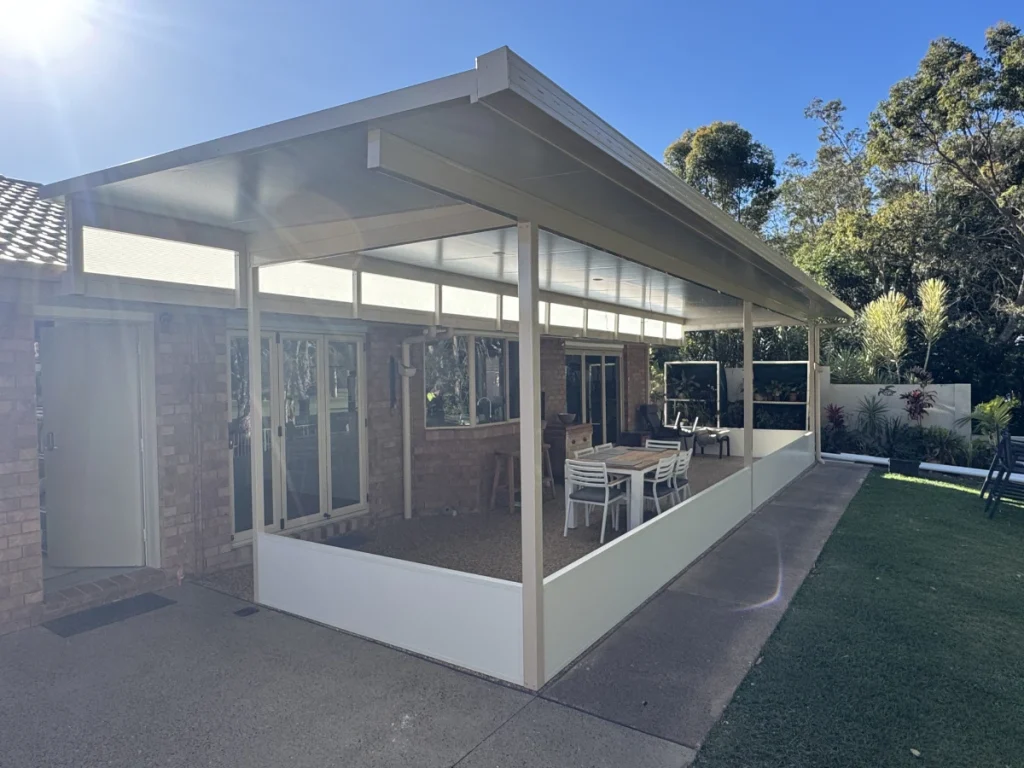
The box gutter approach doesn’t put a single hole in your roof. We take off the existing house gutter entirely and replace it with a structural box gutter, which holds roughly the volume of two house gutters. The structural brackets that carry the new patio go up inside your roof and attach to the trusses, not down through the roof sheets. No penetrations, no leak points, no risk of fasteners working their way loose in ten years’ time.
Because the patio doesn’t have to overlap the house roof to reach a bracket, we can actually pull it back and open up the join, which lets more light into the space. Where the gap would normally let rain in, we fit a polycarbonate infill section. The easiest way to picture it is a frosted bathroom window. Light comes through, but you don’t have a view of dirty roof tiles, and water that hits the house roof stops there and runs into the box gutter rather than dripping under your patio.
For solar, the box gutter is often the answer when a standard flyover isn’t feasible. Because we don’t go through the roof and don’t need the same overlap, we can usually work around the panels without relocating them and without shading them as much as a standard install would.
Two downpipes, painted to match
Two more details that make a difference in the rain.
We run two downpipes side by side from the box gutter rather than one, and join them into a single pipe lower down. The principle is the same as a jerry can. If you only open one end, the liquid comes out in slow glugs because there’s no air going in. Open the other end and the water flows out properly. Two downpipes from a box gutter does the same job. Water out fast, air in fast, no bottleneck during the storms that matter.
We also paint the downpipes to match your house. It sounds small, but most patio builders leave you with a white plastic downpipe stamped with blue manufacturer text running down your wall after they finish. Once you’ve built a beautiful patio, the last thing you want is a marketing decal on the side of the house.
When a standard flyover is still the right call
The honest answer is not every job needs the box gutter. A standard flyover is often the right choice when the budget is firm, when the site is sheltered enough that sideways rain isn’t a real factor, when there are no solar issues, and when the build is smaller in scope. We build plenty of standard flyovers and they do their job well. The point isn’t that the box gutter is always better. It’s that on a Sunshine Coast home, with the storms we actually get and the solar setups people actually have, there are real situations where the box gutter changes how much you’ll enjoy the space.
How to think about the decision
The simplest way we frame it for customers: a standard flyover gives you a roof over your outdoor area. A box gutter flyover gives you outdoor area you can actually use, in the weather we actually get, without compromising your solar or putting holes through the most protective part of your house.
Even the box gutter isn’t guaranteed against the one-in-thirty-five-year storm. The engineers have built in a safety overflow for that case. But for everything short of that, it does what the standard flyover can’t.
A word on price
The box gutter is more expensive to build than a standard flyover. We’re upfront about that. It’s a more complex install, more material in the gutter and infill, and more time on site. In most months, that’s the trade-off you weigh against the long-term benefits we’ve described.
FAQs
Is a flyover patio waterproof?
No flyover patio is fully waterproof because the design has at least three open sides where rain can enter. A standard flyover also has a weather gap above the house roof. A box gutter flyover seals that gap with polycarbonate infill to reduce water entry.
What’s the difference between a flyover and a box gutter flyover patio?
A standard flyover attaches with brackets through your roof and leaves a gap above the house gutter. A box gutter flyover replaces the house gutter, attaches to your roof trusses internally, and seals the join with polycarbonate to keep weather out.
Can I have a flyover patio with solar panels?
Sometimes. A standard flyover needs roof penetrations and often clashes with low-mounted solar panels. A box gutter flyover doesn’t put holes in your roof and usually works around existing panels without relocating them or significantly shading them.
Why does a flyover patio cost more than a standard attached patio?
Flyovers use more material because they sit higher and span further without leaning on your house fascia. Box gutter flyovers cost more again because of the structural gutter, internal truss attachment, and polycarbonate infill that solve the standard flyover’s weaknesses.